













The Derby Ram
At the junction of East Street and Albion Street, in the centre of Derby, there is a very curious statue.
Rather than commemorating a local person of historical importance, as would normally have been the purpose of a public sculpture in this sort of location, the statue depicts a mythical beast known as ‘The Derby Ram’.
This powerful work of art, made up of overlapping voluminous blocks of stone, was created by Michael Pegler and was ‘gifted to the people of Derby’ by the property developers Richardson Cordwell in 1995.
The statue is a faithful translation in stone of the words of a traditional folk song. There are many versions of the ballad, but most begin with the same two verses:
‘As I was going to Darby, Sir / All on a market day, / I met the finest ram, Sir, / That was ever fed on hay.
This ram was fat behind, Sir, / This ram was fat before, / This ram was ten yards high, Sir, / Indeed he was no more.’
Subsequent verses become ever more exaggerated in their descriptions of the ram, claiming that the wool upon his back reached up to the sky; the wool upon his belly sold for forty thousand pounds; the space between his horns was wide enough to build a pulpit; and every leg he stood on covered an acre of ground. And so on.
Should anyone doubt the accuracy of this portrait, Verse 15 asserts that the claims are totally correct:
‘Indeed, Sir, this is true, Sir, / I was never taught to lie, / And had you been to Darby, Sir, / You’d have seen it as well as I.’Pride Park Stadium – home of ‘The Rams’ Photo: Tom McAtee/Getty Without resorting to the creation of a sculpture with the preposterous dimensions of the animal described in the folk song, Michael Pegler has managed to produce a work of art that captures to perfection the gargantuan appearance of the ram.
Many years after the ballad was first sung, the association of a ram with Derby continued with the adoption of the animal, not only as a symbol of the city, but also as a mascot for some of its most famous institutions.
When members of the 2nd Battalion of the Mercian Regiment go on parade, they march behind a ram. The animal chosen to lead them has a regimental number, draws its own rations and is expected to carry a ‘leave card’ when it takes its annual holiday on the Chatsworth Estate!
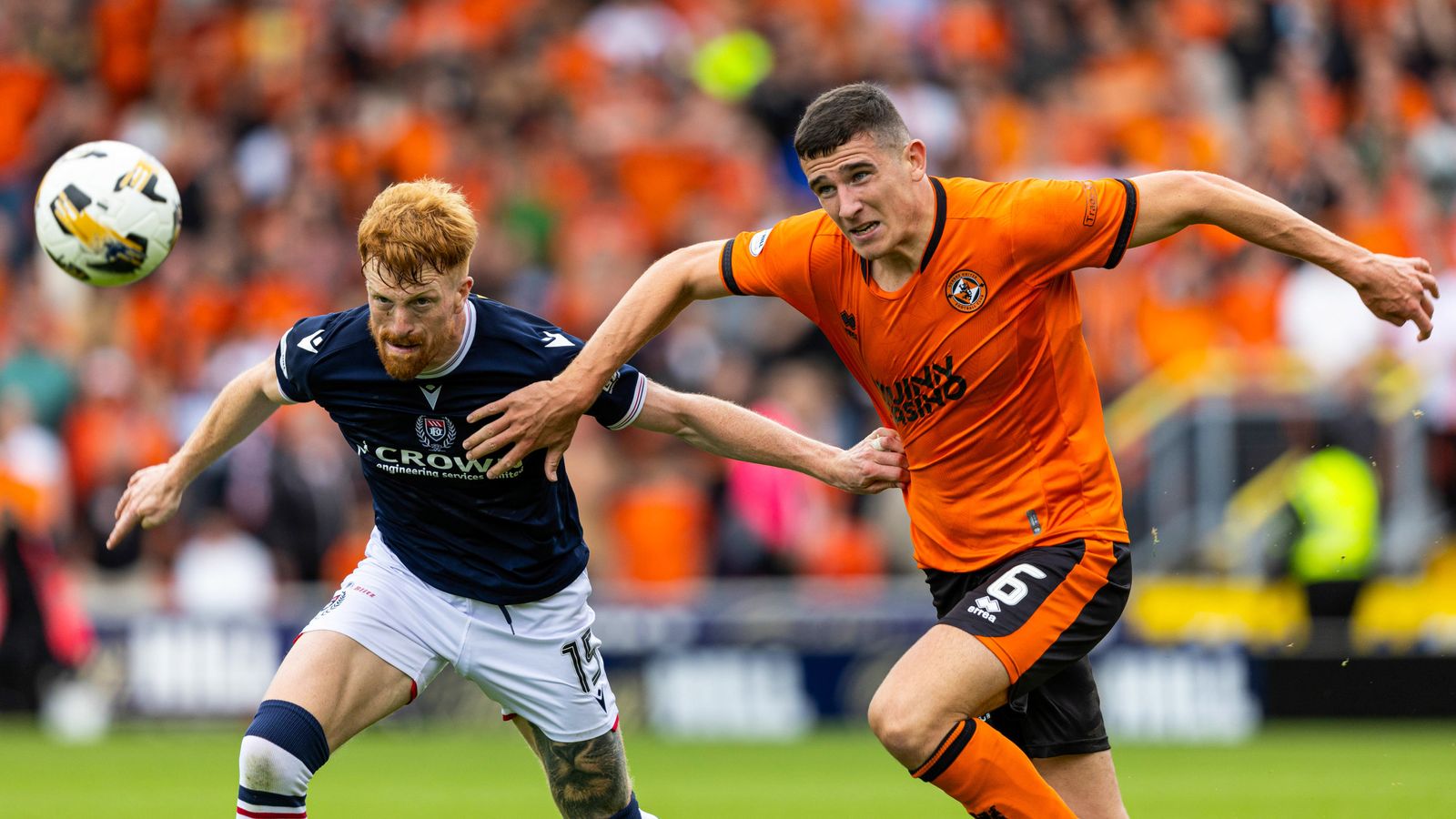
Derby County Football Club are known as ‘The Rams’, and their players wear shirts carrying a depiction of an animal that symbolises their determination to be worthy representatives of a city that is serenaded throughout the world in the folksong called ‘The Derby Ram’.

A sculptural work that is even more unusual in appearance than the statue of the Derby Ram in East Street,is to be found in Liversage Square, a public space in the Castleward District of the city.
Comprising a scattering of 20 gleaming stainless-steel chairs which range from 400mm to 3.5 metres in height, this curious installation is entitled Revealing Castleward.
Designed by Denis O’Connor, a sculptor based in Wirksworth, this highly original artwork is the winning entry chosen from several public art projects that were submitted in response to a competition judged by Quad, Derby City Council, HTA Design, who were the master-planners for the square, and Compendium Living, the company responsible for the redevelopment of Castleward as a desirable residential area.
The urban village that has emerged bears no resemblance to the Castleward of old, which was a conglomeration of cramped dwellings, mills, foundries, forges, woodyards and workshops.
Although much of the early industrial activity in the area was associated with silk manufacture, the many trades that developed in subsequent years included printing, engraving, chairmaking, the manufacture of shoes and the construction of railway carriages.

An area that had played a key part in making Derby a ‘city of trades’ quickly became a sad symbol of ‘a city of lost trades’.
Although the need for wholesale regeneration was clear for all to see, the prospect of wiping away the evidence of Castleward’s thriving industrial past was hard to contemplate.
Of course, some of the artefacts associated with that important historical period could have been preserved rather unimaginatively in a conventional ‘heritage museum’. Thankfully, Denis O’Connor came up with a brilliant alternative solution.
The installation he designed for Liversage Square is not simply a random collection of chairs. On the seat of each chair there are bronze replicas of some of the tools that were used in one of lost trades of Castleward.
With implements employed in 20 different trades being displayed in total, an installation that looks at first sight like a rather bizarre curiosity turns out to be a wonderful ‘open-air museum’.

A walk around the city will bring encounters with many other highly unusual public sculptural works.
A plinth in Irongate dedicated to the memory of Joseph Wright of Derby is topped by an orrery (a model of the Solar System) that mimics the orrery which features in one of his best-known paintings.

Further evidence of Denis O’Connor’s ability to create highly original works of art that celebrate Derby’s industrial heritage is shown in the steel sculptures representing silk bobbins he made as portals at the entrance and exit of the Saint Alkmund’s Way Footbridge.
And, at an entrance to the Derbion Shopping Centre, there is an impressive new sculpture created by Tim Roper of Steel Art.
Its powerful presence in this location brings to mind the opening lines of the traditional folksong: ‘All on a market day, I met the finest ram, Sir.’